Helping Haiti
As you know, Haiti was devastated in January of 2010 with the sole greatest catastrophe of its existence. The January 12th
earthquake affected more people in two minutes than any other event in the country's history combined. Not a single Haitian
was untouched by the effects of this tragedy.
Haiti is currently the poorest country in the Western World and after a recent series of events; earthquake, disease
outbreak, unstable government; Haiti is poised to being one of the poorest countries in the world. Nevertheless, the option to
steer away from this negative path still exists.
In order for any country to advance, develop, and move forward, it needs three basic necessities for living in a modern a
civilization. These items are; Electricity, Transportation and Communications. Haiti presently has no solid infrastructure in
place to support any of these basic requirements for development.
Of all the basic essentials for living in a modern world, the Communications problem is the simplest least expensive
solution to help kick-start Haiti's advancement and modernization.
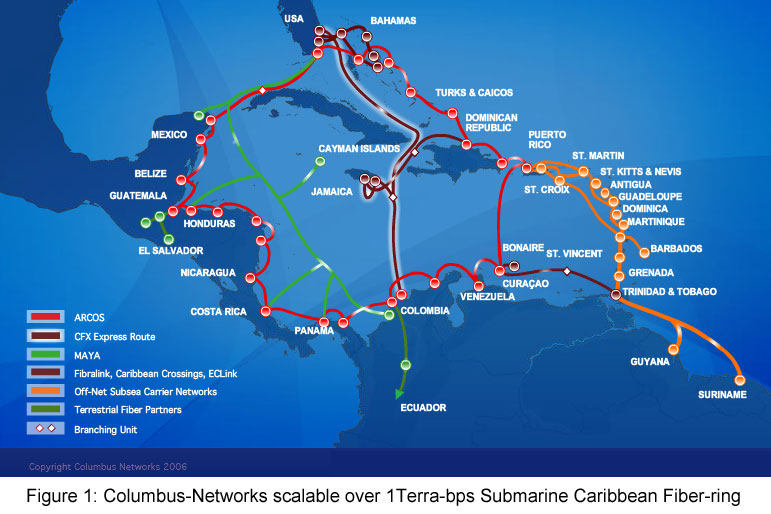
Haiti remains the only free country in the Caribbean not connected to the international sub-marine fiber optic ring
surrounding and connecting all islands in the Caribbean (see figure 1).
All of Haiti's telephone, internet, and electronic communications traffic must enter and exit the country either through
expensive satellite links or piggybacked unstable microwave signals into the Dominican Republic. This situation forces the
Haitian people to pay the most expensive tolls in the region to call and communicate to and from Haiti. The simplest and
most efficient solution to this problem would be to connect Haiti directly to the sub-marine fiber ring at a cost of
approximately $16-20M. With a population of almost 10M this effectively could cost less than $2 per citizen to initiate.
Currently the existing telephone company NATCOM (previously Teleco, now renamed and bought by Vietel a
Vietnamese company) does not have enough capacity to serve Haiti. Years of corruption and lack of investment back into its
infrastructure has left it as the dead last player in the telecommunications race within the country. While there are many key
players in the communications market in Haiti, all find it difficult and very expensive to connect Haiti with the rest of the
world.
The main benefactor in Haiti's telecommunications industry is The Dominican Republic. For Haiti, 80 to 90% off all
phone, internet, fax and electronic transmission must pass through the D.R. to communicate with the U.S., Canada or any
other country in the world. Because Haiti does not have a direct connection to the undersea submarine Fiber system the
country will always be dependent upon another nation to feed its communication demands.
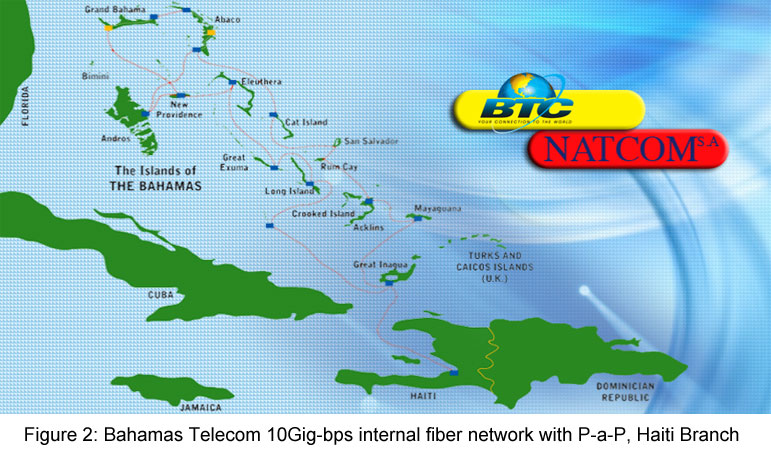
Most recently Bahamas Teleco struck a deal with the old Haiti Teleco phone company to connect their network to
Bahamas' internal link to the submarine fiber system (see figure 2); it is believed that this was an attempt to replace the
Dominican Republic as the communications gateway into Haiti.
<
This attempt has remained stagnant since the Bahamas network was merely an extension of their internal ring and was
designed to make the country of Haiti their single most biggest client. The new NATCOM has still not been able to provide
affordable connectivity using the Bahamas link that is more advantageous over the wireless microwave links into the
Dominican Republic. Much of Haiti's main communication problems rest on the fact that whether with the Bahamas path or
Dominican Republic path both gateways rely on an additional source nation which will always inflate communications costs.
With the Billions of dollars promised to Haiti's recovery it would seem a logical First Step to rebuilding Haiti's
infrastructure and economy would be to invest into connecting the country to the rest of the world in the same manor that
every other free nation is connected. A simple investment of 16M would be the basis of kick-starting the development of High
Speed Internet, cheap affordable long distance rates and a plethora of telecommunication options and services. Very little is
known as to why today Haiti cannot advance into modern times through connectivity to this communications gateway. But
hopefully with enough attention and information more people will be aware of its status and through the aid of the
international community, substantial government grant programs, private investor interest and the aid of the Haitian Diaspora
enough noise can be made to bring this situation to light.


